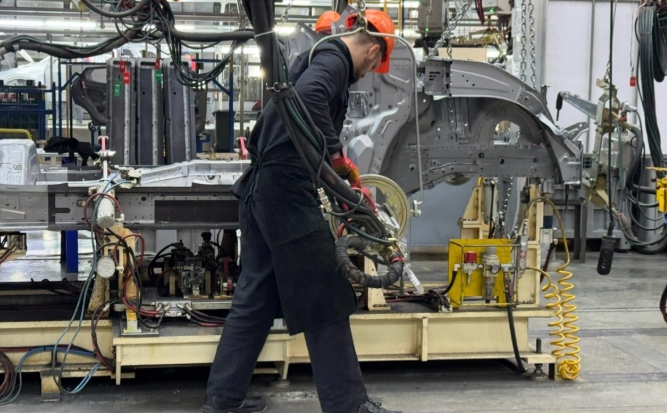
From the classroom straight to the machine tool: Kazakhstan is developing dual education so that graduates arrive at factories with hands-on experience. Read how this works in practice in this report by a Kazinform correspondent.
Not just education, but real-world production
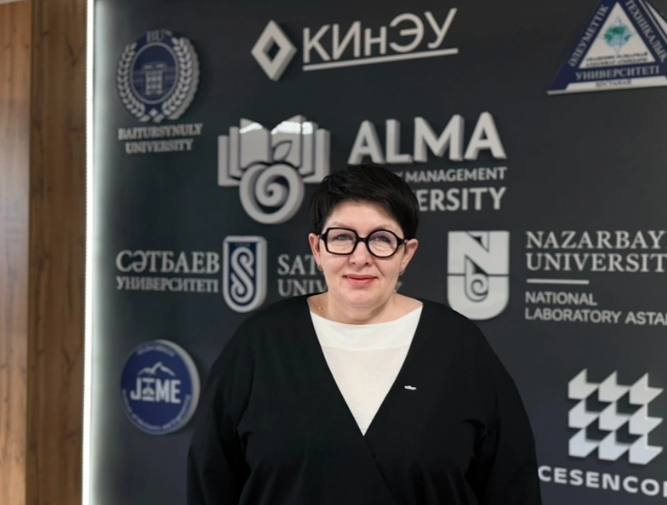
Lyudmila Olkinyan, director of the corporate university, spoke about the importance of dual education for the engineering sector. According to her, for the company, this has long since ceased to be merely an additional training format and has become part of a broader human resources development strategy.
As the speaker noted, at a certain point it became clear: the automotive industry in Kazakhstan lacks its own specialists, and the labor market cannot keep up with the industry’s needs.
— We don’t just manufacture cars. Today we can confidently say that this is also about human resource development. And dual education is precisely part of a larger strategy for human capital development, she emphasized.
According to her, the problem of staff shortages was particularly acute in the early days of the domestic auto industry.
“In 2013, when I started working at the plant, we were actually faced with a complete lack of automotive personnel in the labor market in general. We started training employees abroad and inviting specialists from abroad. It was a never-ending and very expensive process, but we had to learn,” she explained.
That is precisely why, she said, the shift toward dual training proved timely and aligned with business needs.
“Around 2016, the government announced a policy on dual vocational training. And this was in line with business needs. We studied international experience—from Belarus, Russia, Korea, and Japan. And today we can confidently say that we have our own Kazakhstani model of dual vocational training,” she noted.
How the system works
According to the speaker, the system does not begin with practical training per se, but with the joint adaptation of the educational program to meet the needs of production.
— First, an agreement is signed with the educational institution. Then we take the educational program, review it, and say: “Guys, here are the specific competencies we need for the plant.” In other words, we modify the program itself. But it’s not enough to just change it—it needs to be filled with content. And the students are already learning the practical side here with us, on the production floor,” explained the director of the Allur Corporate University.
She specifically emphasized that a future engineer must not only study theory but also go through real-world work processes.
“A good engineer must go through the training of a mechanic, a welder, and a process engineer. This is what needs to be changed in the dual education system today," she said.
According to her, this is precisely where the line between formal training and actual entry into the profession lies. A student who sees production only in pictures and a student who has stepped onto the production line represent two completely different levels of readiness.
— He already knows not only how everything works, but also our pain points. There’s no such thing as a perfect production process; there are always processes that need improvement. And the guys who worked with us suggested on their own what could be changed, automated, and where to eliminate unnecessary manual labor, — she explained.
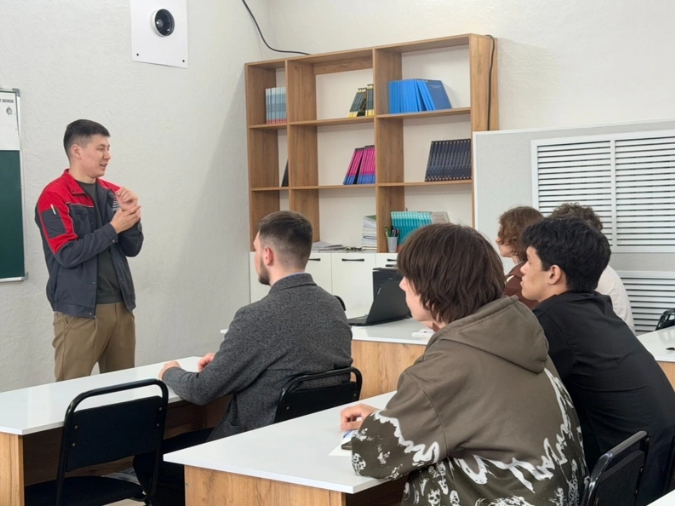
Future production workers doing their internships at the plant note that dual education allows them not only to reinforce their theoretical knowledge but also to gain real professional skills.
Alexander Maslovsky, a student at the Kostanay Polytechnic College, works as a mechanical assembly fitter on the assembly line, is learning to operate modern equipment, and emphasizes the importance of adaptation and team support for professional growth.
Timur Antonov, a student at Eurasian National University who is interning in the body shop, participates in technical inspections and equipment optimization, noting that it is precisely this hands-on experience that helps him gain a deeper understanding of the profession, develops responsibility and communication skills, and motivates him to pursue a career in mechanical engineering.
From School to an Engineering Career
According to Lyudmila Olkinyan, the dual model should encompass not only universities but also colleges and even schools. Yasmin Aubakirova, a student at the Gorky Gymnasium, said that her interest in engineering began thanks to 3D modeling classes at the school affiliated with the corporate university.
“I’ve been doing 3D modeling since fourth grade. It seemed like something new and interesting to me, and I thought I could tie my future career to it,” she noted.
According to her, participating in such programs is already yielding results.
“I’m a medalist at the national WorldSkills Kazakhstan championship and a multiple medalist at the regional levels. This year, I plan to compete in the international championship,” the student added.
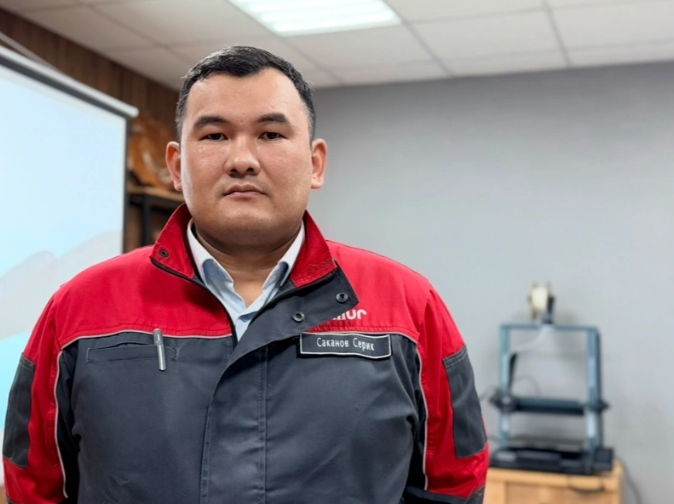
As Serik Sakanov, chief specialist at the dual education center, explained, this system allows for a continuous training pathway.
“It’s a transition from school to college or university and then on to the workplace. This bridges the gap between education and industry,” he noted.
The next step is working with colleges. In Kostanay, this involves the local Higher College of Automotive Transport, where closer cooperation with industry has been established. As the college’s director, Dmitry Pavlenko, explained, the institution initially trained specialists in automotive maintenance and repair, but over time, a need for a new specialization arose.
“Previously, we trained personnel mainly for service centers and dealerships. But manufacturing required a separate specialty—automotive engineering. We obtained a license and began structuring our training program to meet these needs,” he noted.
According to him, one of the key requirements was the creation of our own material and technical base, as close as possible to real-world production.