Over the past ten years, Kazakhstan’s machine-building industry has increased its output 8.5-fold. But behind these impressive numbers lies a paradox: a country that assembles locomotives for the CIS and cars for the entire region still imports nearly half of its engineering products from abroad. A Kazinform correspondent examined the issue in detail.
The Math Behind the Boom
Kazakhstan’s machine-building industry today comprises more than 5,000 enterprises and 37 sub-sectors. The industry’s share of the country’s manufacturing sector has come very close to 20%. And while ten years ago it was a modest industrial sector, today it is one of the main drivers of the non-resource economy.
“While production volume stood at 670 billion tenge in 2015, by 2025 it reached a historic high of 5.7 trillion tenge—an 8.5-fold increase,” reported the Association of Kazakhstan Machinery Industry .
Behind the numbers lie specific manufacturing operations. Today, passenger cars from Hyundai, KIA, Chevrolet, and Lada are assembled in Kazakhstan. Freight cars and locomotives are built. 500-kV power transformers and lead-acid batteries are manufactured. Cables, capacitors, and buses are produced. And all of this is done at domestic plants, often with a high degree of localization.
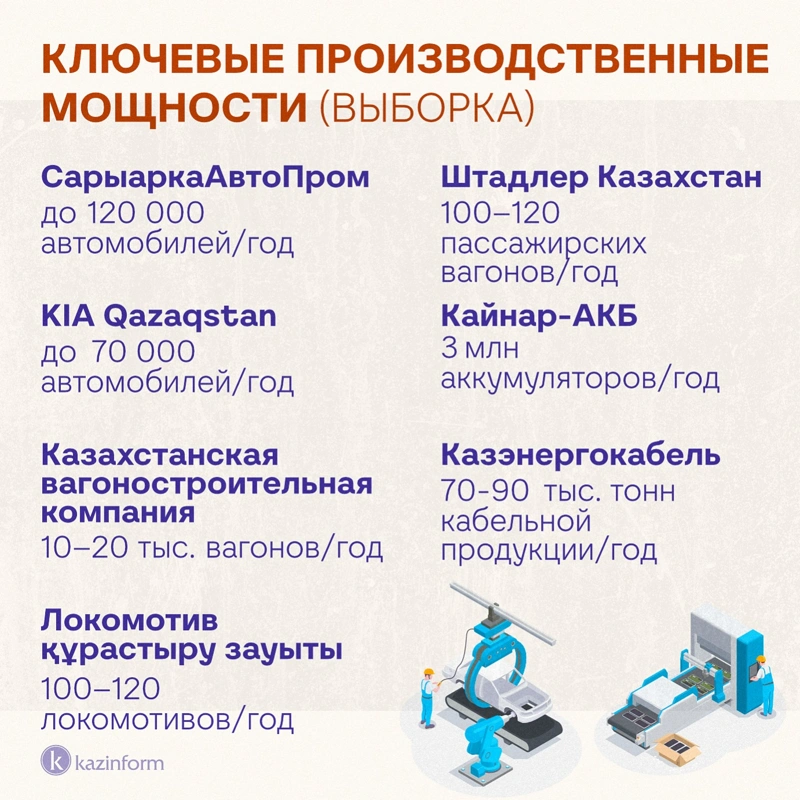
According to the Ministry of Industry and Construction, this growth is driven by a combination of factors: the expansion of automobile production, the launch of railcar manufacturing facilities, and the development of the electrical engineering sector. Key players include SaryarkaAvtoProm LLP (up to 120,000 cars per year), Astana Motors Manufacturing Kazakhstan LLP (90,000–120,000), and KIA Qazaqstan LLP (70,000). If we add up the production capacities of just these three largest automakers, the total comes to nearly a third of a million vehicles annually.
The Paradox of Growth: Nearly Half Are Imports
One might think that with such growth in production, imports should be declining. But the statistics cast doubt on this logic. According to the Association of Kazakhstan Machinery Industry, machinery and equipment account for about 44% of the country’s total imports—approximately 25.5 billion U.S. dollars. This is not just a large number. It is both a verdict and a call to action.
“Machinery products account for about 44% of the country’s total imports (approximately $25.5 billion). This means that the industry still has significant potential to increase domestic production and reduce dependence on imports,” stated the Association of Kazakhstan Machinery Industry.
In other words: for every five dollars Kazakhstan spends on imports, two go to areas where domestic factories are not yet able—or have not yet managed—to meet the demand.
This is no reason for discouragement—it’s a roadmap of opportunities. That’s exactly how the Association of Kazakhstan Machinery Industry views the situation:
“While the current focus is largely on import substitution, the next stage will be export expansion and integration into global supply chains.”
Where does this gap come from? The answer lies in the anatomy of the industry. Production is growing, but not always where it’s needed. Cars are assembled—but the components are purchased. Railcars are built—but they depend on imported wheels and rolled metal. Cables are manufactured—but some of the raw materials are sourced from abroad. According to the general assessment of market participants, localization has not yet reached the level at which the supply chain becomes truly self-sufficient.
Six Challenges That Have Become Chronic
The Association of Kazakhstan Machinery Industry is just as candid as the Ministry of Industry and Transport. In its analysis, the industry association identifies six systemic challenges—and each of them requires not a piecemeal solution, but a structural one.
1. Raw Material Shortages
The first problem is dependence on metallurgical imports: “One of the problems is dependence on imports of metallurgical products.” Although Kazakhstan mines iron ore and has its own metallurgical capacity, the machine-building industry’s demand for high-quality rolled steel, sheet steel, and tool steel is often met through imports. There is, however, an encouraging precedent here: the QazTehna plant is already using 08KP galvanized steel produced by the Qarmet plant. According to the Ministry, this not only reduces dependence on imports but also opens up new market segments—in particular, automotive component manufacturing.
2. Shortage of Long-Term Orders
A manufacturer will not invest in modernization if it is not confident about sales. This is precisely the crux of the matter: major consumers (state-owned companies, infrastructure holding companies) often do not set long-term production targets but instead operate on short tender cycles. The Union prioritizes solving this problem and insists on the introduction of off-take contracts as a mechanism to guarantee sales.
3. Robotization: 9 vs. 162
The most telling metric of industrial lag is robot density. The figure cited by the Union reads like a diagnosis:
“In Kazakhstan, there are about 9 industrial robots per 10,000 workers in the manufacturing sector, while the global average is around 162,” the AKMI added.
With such a gap in automation, it is extremely difficult to compete with foreign manufacturers on production costs. And this is not just a matter of productivity—it is a matter of the industry’s survival in the open market.
4. Physical and Moral Depreciation of Equipment
The Ministry of Industry explicitly identifies equipment depreciation as a key constraint: “The obsolescence of production lines leads to a high defect rate, increased energy intensity of production, and an inability to compete with imports even on price due to high production costs.” In other words, an old factory is unprofitable not only from a technological standpoint—it is also unprofitable financially.
5. Labor Shortage
The industry lacks lathe operators, milling machine operators, CNC machine operators, design engineers, and process engineers. And it’s not just a matter of quantity—it’s a matter of the quality of training. As the Ministry notes, employment among young people aged 15–34 in the manufacturing sector in the second quarter of 2025 fell by 8.8% compared to the same period a year earlier. Educational programs, by general consensus, are out of touch with the industry’s real needs.
6. Barriers in Export Markets
Even competitive products do not automatically break into foreign markets. International certification, service infrastructure, and marketing expertise are required. All of this represents additional investment that small and medium-sized enterprises cannot shoulder on their own.
What the Government Is Already Doing
These challenges are not being ignored. The system of government support is structured along several lines—financial, tax, and institutional. Companies in free economic zones are provided with a full package of incentives: a zero corporate income tax rate for up to 10 years or more, exemptions from land tax, property tax, VAT on imported raw materials, and customs duties. Additionally, they receive land grants, infrastructure, and a simplified procedure for hiring foreign specialists.
“In accordance with established regulations, machinery manufacturing enterprises are provided with government incentives in the form of partial cost reimbursement for: certifying the conformity of domestic goods, enhancing employee competencies, implementing digital technologies, and improving technological processes,” stated the Ministry of Industry and Construction of the Republic of Kazakhstan.
Through the structures of the “Baiterek” Holding, various instruments are available, including preferential financing and interest rate subsidies (JSC “FRP ‘Damú’”), lending for investment projects and export operations (Development Bank of Kazakhstan), and leasing and industrial lending (Industrial Development Fund).
Recently, a portion of the costs associated with rail transportation of products from the manufacturer to the consumer within the country has also been reimbursed. This may seem like a minor measure—but for companies operating in remote regions that face high logistics costs, it could prove to be critically important.
On the horizon for 2026–2030 is a Comprehensive Plan for the Development of the Machinery Industry, which calls for digitalization, robotization, and a “multiplier effect on labor productivity.” The main tools include the implementation of professional standards, tax incentives for investors, and a large-scale workforce training program.
The Railway Cluster: A Success Story
If one were to look for a sector within the machine-building industry that has already evolved from simple assembly production to a full-fledged cluster, it would be railway engineering. Here, Kazakhstan does not merely occupy a niche in the market—it shapes the supply for the entire 1,520-millimeter gauge.
According to the Association of Kazakhstan Machinery Industry, a “cluster has effectively been formed” in the railway engineering sector: it includes companies from the Railways Systems KZ group, Stadler Kazakhstan, Alstom, and Wabtec.
The product range is comprehensive. Freight and passenger cars are manufactured by the “Kazakhstan Car Building Company” and RWS Wagon (“ZIKSTO”). Locomotives are produced by “Locomotive Assembly Plant” (in partnership with Wabtec) and “Electric Locomotive Assembly Plant” (with Alstom). Wheels and track superstructure components are produced by Prommashkomplekt LLP (part of the RWS group). Rails are produced by the Aktobe Rail and Beam Plant.
The products are already being exported to Azerbaijan, Vietnam, and Central Asian countries. France’s Alstom is investing in the construction of service centers in four cities in Kazakhstan and is developing a new-generation locomotive in collaboration with Kazakhstani companies. According to the Union, more than 50 Kazakhstani supplier companies work with “Elektrovoz Kurastyru Zauyty” LLP.
The electrical engineering sector is following a similar path. The Alageum Electric Group manufactures power transformers with a capacity of up to 500 MVA and a voltage of up to 500 kV at “Asia Trafo,” the largest plant of its kind in Central Asia. Its production capacity is 10,000–15,000 transformers per year. Its sales markets cover the entire region.
New Investors: Samsung, John Deere, Hyundai
One of the major developments in Kazakhstan’s machine-building industry in recent years has been the arrival of major foreign brands, which bring not only capital but also technology, quality standards, and export networks.
In 2025, with the participation of Samsung Electronics, a joint venture for the production of home appliances—washing machines and televisions—was launched at the facilities of Silk Road Electronics LLP in the city of Saran. At the same time, the “ALMATY TURMYSTYQ TEHNIKA ZAVODY” plant is under construction in the Almaty Region, with a planned capacity of up to 750,000 units of home appliances per year and the creation of more than 1,200 jobs.
In the automotive sector, mass production of multimedia systems (Kazakhstan Mobility Engineering) began in 2025 in partnership with South Korea’s Motrex Co., Ltd. YOUNGSHAN has set up production of car seats for Hyundai vehicles.
In agricultural machinery, a global leader has made a full-scale entry: John Deere has established production at the Localization Center of Agromashholding KZ JSC’s plant. Welding, cutting, bending, painting, and assembly are carried out here. Nearby are the already established brands CLAAS, DEUTZ-FAHR, AMAZONE, ZOOMLION, and LOVOL.
“While the current focus is largely on import substitution, the next stage is export expansion and integration into global supply chains. This is precisely what can make the machinery industry a sustainable driver of Kazakhstan’s long-term economic growth,” noted SMK.
Workforce: The Hidden Shortage
A factory can be built quickly, and equipment can be purchased. But it is impossible to train a skilled lathe operator proficient in modern CNC systems in a short period of time. It is precisely this labor shortage that remains a systemic problem for Kazakhstan’s machine-building industry, and this is openly acknowledged by both the Ministry and the industry association.
The picture is as follows: the share of the employed population (aged 15–34) in the manufacturing industry as of the end of the second quarter of 2025 stood at 218,500 people, which is 8.8% less than during the same period in 2024.
The decline in youth employment in the sector amid rising production is a warning sign.
The shortage is most acute in two categories. The first is blue-collar trades: lathe operators, milling machine operators, and CNC machine operators. The second is engineering roles: design engineers, process engineers, and automation specialists. Vocational schools have not yet risen to the challenge—their programs are generally considered to be out of touch with the real needs of manufacturing.
The response to this has been the expansion of the dual education system. Today, dual training is offered at 284 colleges, 164 of which operate in the manufacturing sector. More than 700 companies are involved in the system. Each year, the program secures permanent employment for more than 13,000 young professionals.
Flagship examples include the Allur Corporate University in Kostanay and the Kentau Polytechnic College, where students complete internships at the production sites of the Allur Group and Alageum Electric. Petropavlovsk College of Mechanical Engineering and Transportation—400 students in vocational programs, 60% of their practical training takes place at local factories, and the curriculum is tailored to employers’ specific requests.
At the international level, programs such as Erasmus+ (internships at European industrial centers), DAAD (scholarships in industrial engineering and “Industrial AI”), JICA (Japanese expertise in high-precision manufacturing and the “Kaizen” system), and KOICA (Korean leaders in automotive engineering and robotics) are available.
Exports: Where Kazakhstani Machinery Is Headed
The export landscape for Kazakhstan’s machinery industry remains concentrated: neighboring countries remain the primary market. According to data from the Union of Machine Builders, preliminary results for 2025 show that over 53% of the industry’s exports go to Russia, followed by Uzbekistan (8.1%), Kyrgyzstan (5.3%), Turkmenistan (4.7%), and Tajikistan (3%).
This overall geographic focus is understandable: CIS countries use a 1,520 mm rail gauge—a technical standard that Kazakhstani rolling stock manufacturers are geared toward. But market diversification is already on the agenda. Shipments to Vietnam and Azerbaijan represent the first steps in this direction.
The export potential for electrical equipment, agricultural machinery, and household appliances extends far beyond the current geographic scope of shipments. The challenge lies in certification, after-sales support, and marketing presence in markets that Kazakhstani manufacturers are still working to enter.
2026: What Lies Ahead
In April 2026, Kazakhstan will host the 13th Forum of Machine Builders—the main platform for dialogue between the government and the business community. The agenda includes industrial cooperation, automation, export potential, the investment climate, and human resources policy.
The agenda includes industrial cooperation, automation, export potential, the investment climate, and human resources policy. But, in essence, the forum addresses the same issue every year: how to translate production growth into increased competitiveness.
At the national level, the Comprehensive Plan for the Development of the Machinery Industry for 2024–2028 remains the key document. Its priorities include the digitalization of manufacturing, the implementation of industrial AI and IoT, additive technologies (3D printing), the use of new materials, and energy efficiency.
Kazakhstan’s machine-building industry has come a long way—a journey that is hard to underestimate. A growth of eight and a half times over ten years is not a statistical error; it is a structural shift. But with imports accounting for 44% of the sector’s total and only 9 robots compared to the global average of 162, this is an equally clear signal of where more work still needs to be done.
The paradox of this industry is that it has an impressive past, but its present is still taking shape. Factories are being built, investors are coming in, dual-track education is expanding, and exports are growing—and all of this adds up to a dynamic picture that has not yet evolved into a sustainable industrial ecosystem.
Sourse: inform.kz